
Teach Drama

📖 Table of Contents
- Why Drama Is a Powerful Teaching Tool
- Simple Drama Activities for Kids
- The Benefits of Teaching Drama in the Classroom
- Tips for Teaching Drama to Younger Children
- How to Adapt Drama Activities for Different Class Sizes
- Expert Tips and Advanced Techniques
- Tools, Materials and Resources
- Tools, Materials and Resources
- Troubleshooting and Common Questions
- Troubleshooting and Common Questions
- Getting Started: Your First Steps
- Make It Your Way
- Frequently Asked Questions
The first time I taught a drama class to a group of 8-year-olds, I was nervous. I had prepared a lesson on character development, but I didn’t expect the kids to come alive so quickly. They weren’t just learning lines—they were embodying characters, laughing, and expressing themselves in ways I hadn’t imagined. That moment changed how I approached teaching drama. It became clear that drama wasn’t just about performance; it was about connection, creativity, and confidence. That’s why I started writing this blog, to help other educators bring the magic of drama into their classrooms.[4]
Teaching drama to kids isn’t just about fun—it’s about learning. When I began working with students in kindergarten, I noticed that even the shyest children would open up during role-play exercises. The classroom transformed into a space where creativity was celebrated and where communication skills flourished. It was then that I realized how powerful drama could be in education. Whether it’s helping children build empathy through storytelling or improving public speaking skills through improvisation, drama has the ability to shape young minds in profound ways.[5]
What I love most about teaching drama is that it’s accessible to everyone. You don’t need a theater or expensive props to make it work. A simple game, a few props, and a willingness to play can turn any classroom into a vibrant stage. As I learned more about the impact of drama on students, I became more committed to sharing practical, hands-on techniques that teachers can use every day. That’s where this article comes in. It’s a guide to help you teach drama with confidence, creativity, and purpose.
Why You'll Love This Drama Teaching Guide
- Helps kids develop empathy and communication skills in a fun way
- Requires minimal materials and preparation
- Encourages creativity and confidence in every student
- Can be adapted for various age groups and classroom settings
Why Drama Is a Powerful Teaching Tool
As of August 2026, Drama is more than just acting—it’s a way for children to explore different perspectives, develop empathy, and build social skills. When kids step into the shoes of a character, they begin to see the world from a new angle. I remember one lesson where we performed a scene from a book, and the students were able to articulate the motivations of their characters in a way that surprised even me. Drama helps kids understand complex emotions and relationships that they might not be able to grasp in traditional lessons.[1]
In addition to emotional development, drama enhances communication skills. Kids who are shy or hesitant to speak in class often find their voice during a drama activity. They learn to listen, react, and collaborate with their peers in ways that are both meaningful and memorable. One of the best parts of teaching drama is watching students who rarely participate in class become confident and expressive.
There’s also a strong connection between drama and academic learning. Studies show that students who engage in drama activities often perform better in subjects like reading and writing. Drama encourages creativity, critical thinking, and imagination—skills that are essential in all areas of education. As an educator, I’ve seen firsthand how drama can transform a classroom into a space where learning is not only effective but also joyful.[2]
When teaching drama, use real-life scenarios or stories that resonate with students. It helps them connect emotionally and think more deeply about the material.
In this guide:
In this guide:
In this guide:
In this guide:
In this guide:
In this guide:
Simple Drama Activities for Kids
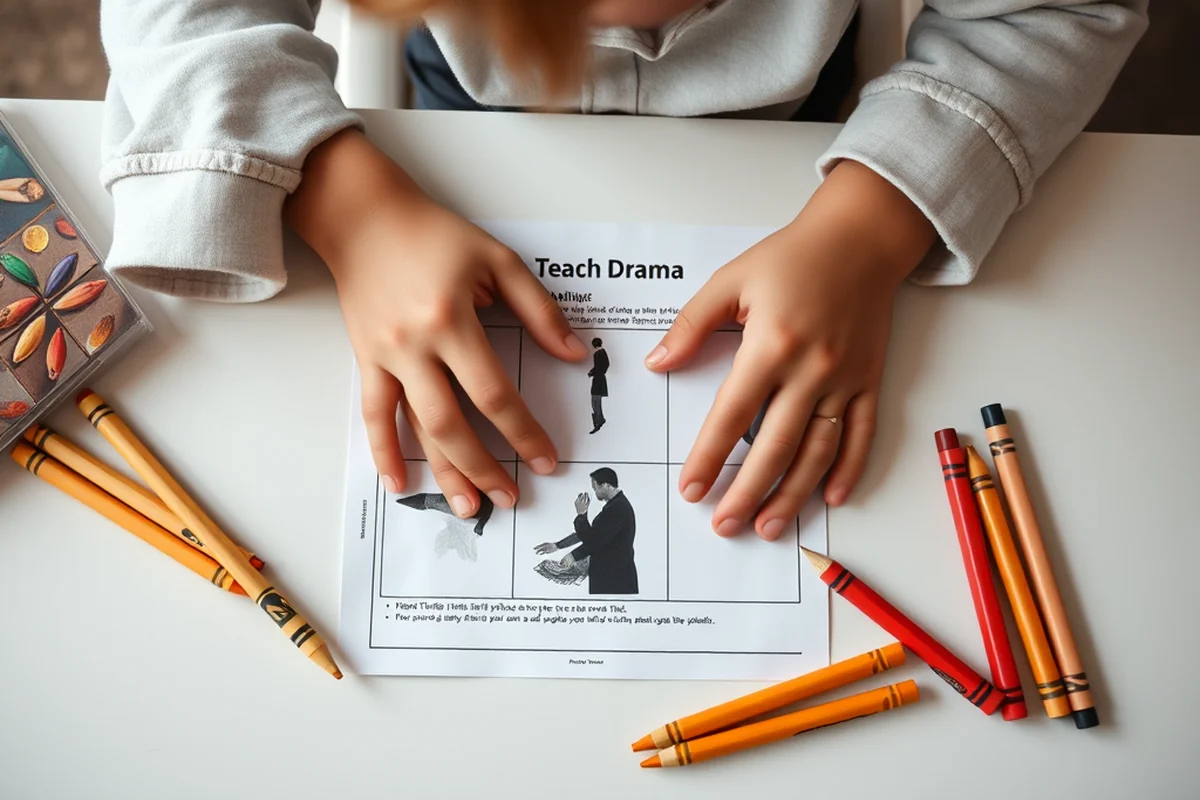
One of the easiest ways to introduce drama to kids is through role-play. You can set up a scenario, like a grocery store or a spaceship, and let the students act it out. This activity is great for building confidence and creativity, and it can be adapted to any theme. Another fun activity is 'freeze frames,' where students create still images to represent a moment from a story or a feeling. It’s a great way to explore emotion and body language.
Storytelling is another excellent way to engage kids in drama. You can start a story and let the students continue it, encouraging them to use their imagination and take turns speaking. This helps develop narrative skills and collaboration. I’ve used this activity with students as young as 5, and it’s amazing how quickly they pick up on the flow of a story.
These activities don’t require any special equipment. All you need is a few props, like a hat or a scarf, and a willingness to play. The key is to keep it simple, fun, and engaging. When kids feel comfortable, they’re more likely to take risks and try new things.
Drama is the bridge between imagination and learning.
Related: Why Do Kids Sleepwalk
Related: What Is The Rationale For Teaching Drama
Related: Can You Teach Kids On Preply
Related: Teaching Drama High School
Related: Teaching Drama The Essential Handbook
Related: Children'S Of Alabama
Related: Children For Cinema
Related: Purpose Of Drama
Related: The Kid Detective Cast
Related: High School Movies
Related: Little House On The Prairie
Related: Dolly Parton Children
The Benefits of Teaching Drama in the Classroom
One of the most significant benefits of teaching drama is the way it helps students develop empathy. When kids step into the shoes of a character, they begin to understand different perspectives and emotions. This can be especially powerful when exploring stories with diverse characters or complex themes. I’ve seen students who were initially reluctant to participate become deeply engaged when they were able to relate to a character’s experiences.
Creativity is another key benefit of drama. Drama encourages students to think outside the box and come up with original ideas. Whether it’s creating a new character, writing a dialogue, or designing a scene, drama gives students the freedom to express themselves in unique ways. This kind of creative thinking is valuable in all areas of education.
Communication skills are also greatly enhanced through drama. Students learn to listen, speak clearly, and collaborate with their peers. These skills are not only useful in drama class but also in subjects like English, history, and science. When students are able to express their thoughts and ideas confidently, they become better learners overall.
Make sure to create opportunities for students to work together in drama activities. Collaboration helps build teamwork and communication skills.
“The first time I taught a drama class to a group of 8-year-olds, I was nervous.”— Teaching Drama to Kids editors
Tips for Teaching Drama to Younger Children

Teaching drama to younger children requires a different approach than teaching older students. The key is to keep the activities simple, engaging, and age-appropriate. For children under 8, it’s best to use short, interactive games that don’t require long periods of concentration. Activities like 'mirror play,' where students copy each other’s movements, or 'sound effects,' where they make noises to represent different animals or vehicles, are great for younger kids.
Visual aids are also important when teaching younger children. Using pictures, props, or even simple drawings can help them understand the activity and stay focused. I’ve found that using a large, colorful poster to introduce a new scene or character makes a big difference in keeping the class engaged.
It’s also important to keep the tone of the class fun and playful. Young children respond well to games and imaginative play. If you make the class feel like a game, they’re more likely to participate and enjoy the activities. The goal is to create a space where they feel comfortable and excited to explore their creativity.
How to Adapt Drama Activities for Different Class Sizes
Class size can be a challenge when teaching drama, but with the right approach, it can be managed effectively. For larger classes, it’s a good idea to break the students into smaller groups and have each group perform a different part of the activity. This way, everyone gets a chance to participate without feeling overwhelmed.
Another way to adapt drama activities is to use individual roles. Instead of having the whole class perform at once, assign specific roles to each student, such as narrator, actor, or director. This helps keep everyone involved and gives them a clear purpose in the activity.
Rotating stations is another effective method for managing larger classes. Set up different drama stations around the classroom, each with a different activity, and have students rotate through them in small groups. This not only keeps the class moving but also ensures that everyone gets a variety of experiences.
Expert Tips and Advanced Techniques
Expert dramatists emphasize the importance of cold reading to quickly interpret and embody a character without prior preparation, sharpening improvisational skills. This technique is invaluable in auditions and live performances, where adaptability is key.[3]
Advanced techniques such as Meisner technique and Stanislavski’s system encourage actors to draw from personal emotions and experiences to create authentic, layered performances. These methods help students delve deeper into character motivations and relationships.
Ensemble work is another crucial advanced technique, promoting collaboration and unity among actors. It teaches students how to support each other’s performances and maintain cohesion within a group, essential for successful theatre productions.
Tools, Materials and Resources
Essential tools for drama education include scripts, costumes, and props that bring scenes to life. These materials help students visualize and immerse themselves in different characters and settings.
Recording devices and video cameras are invaluable for self-assessment and feedback. Students can review their performances, identify areas for improvement, and refine their acting techniques with the help of teachers or peers.
Online platforms and apps offer access to virtual workshops, tutorials, and script libraries, making drama education more accessible and versatile. These resources support both classroom learning and independent practice.
Troubleshooting and Common Questions
One of the most common challenges in teaching drama is encouraging student participation, especially in shy or introverted learners. Techniques such as group work, role-playing, and peer feedback can help build confidence and encourage involvement.
Another frequent issue is the lack of materials or space for dramatic activities. Educators can overcome this by using imagination, repurposing everyday objects as props, and utilizing school spaces creatively, such as hallways or outdoor areas.
Time constraints and curriculum demands can also be a challenge. Incorporating drama into other subjects or using short, focused activities can help integrate drama education effectively without overwhelming the schedule.
Getting Started: Your First Steps
To start teaching drama, familiarize yourself with core concepts such as acting techniques, stagecraft, and script analysis. This foundational knowledge will help you design engaging and informative lessons for your students.
Gather essential resources like scripts, props, and performance spaces. Investing in practical tools and creating a dedicated space for rehearsals can significantly enhance the learning experience.
Set clear goals for your drama program, whether it's improving confidence, developing performance skills, or exploring storytelling. Having a vision will guide your teaching and keep students motivated throughout the journey.
🎭 Younger Kids (3-6)
Use simple role-play and sound effects to engage very young children in creative play.
🎭 Older Kids (7-12)
Introduce more complex scenes, character development, and group improvisation for older students.
🎭 No-Prep Version
Use everyday objects as props and create spontaneous activities that require no prior planning.
🎭 Group Version
Set up collaborative activities that require teamwork, such as creating a group story or performance.
🎭 Extension Activity
Encourage students to write and perform their own short plays, building on their drama skills.
| The mistake | Why it happens | The fix |
|---|---|---|
| Not allowing enough time for students to prepare or think | Students need time to process and engage with the material. Rushing them can lead to frustration and disengagement. | Build in time for discussion, practice, and reflection before expecting students to perform or participate. |
| Focusing too much on performance rather than learning | When students feel like they’re being judged for their performance, they may become anxious and disengaged. | Emphasize the learning process over the outcome. Celebrate effort and participation, not just the final performance. |
| Not adapting activities for different learning styles | Students learn in different ways—some are visual, some are auditory, and some are kinesthetic. Activities that don’t cater to these differences may leave some students behind. | Use a variety of activities that incorporate movement, visuals, and verbal participation to ensure all students are engaged. |
| Ignoring the emotional impact of drama | Drama can bring up strong emotions, and students may not always be ready to express them. Ignoring these emotions can lead to discomfort or disengagement. | Create a safe and supportive environment where students feel comfortable expressing their emotions. Be sensitive to their needs and provide guidance when necessary. |
Teach Drama
Common Questions
How can I celebrate Teachers Day with a drama activity?
How do I teach theater to kids who are shy or hesitant?
What are some drama activities that require minimal supplies?
How can I adapt drama activities for different learning levels?
Cite this guide
Teaching Drama to Kids (2026). Teach Drama. https://dramaplayarea.com/teach-drama/
Feel free to cite or share this guide.
References
- Theatre Education, PreK-12 - Arizona Department of Education (azed.gov)
- Drama Teacher - Berklee College of Music (berklee.edu)
- (PDF) Teaching Drama: Challenges and Benefits - Academia.edu (academia.edu)
- Teaching with drama | National Museum of American History (americanhistory.si.edu)
- Publicly Available Data Sources | National Endowment for the Arts (arts.gov)