
Teaching With Drama
📖 Table of Contents
- What is Teaching With Drama?
- Why Drama Works in the Classroom
- How to Get Started With Teaching With Drama
- Making the Most of Drama in Your Classroom
- The Role of Teachers in Teaching With Drama
- The Impact of Teaching With Drama on Student Learning
- Making Drama Inclusive and Accessible
- Make It Your Way
- Frequently Asked Questions
I remember the first time I used drama in my classroom — it wasn’t the sparkly costumes or the big stage that made it work. The way my students suddenly began to think differently. When we acted out a scene from a story, one of my shyest students stepped forward and delivered a line with such confidence that I nearly dropped my clipboard. That moment, when the abstract became real, was the moment I knew teaching with drama wasn’t just a strategy, it was a transformation. I’ve since spent years refining techniques that bring out the best in young minds.[1]
Teaching with drama is more than just performance — it's a bridge to empathy, creativity, and expression. It’s the way a child can step into the shoes of a character and come out with a deeper understanding of emotions, or how a group can collaborate on a scene and learn the value of teamwork. I've seen it work in every grade level I've taught, from kindergarten to middle school, and the results are consistently heartwarming and effective. It's not just about fun; it's about learning through doing, which is one of the most powerful ways children retain knowledge.
The key to teaching with drama lies in intentionality. It’s not about making every class a play, but rather using drama as a tool to make learning more immersive and meaningful. Whether it's through role-play, improvisation, or storytelling, the right approach can turn even the most abstract concepts into tangible experiences. I've tested this with my students for over a decade. The data speaks for itself — children who engage in drama regularly show improved communication skills, higher engagement, and more confidence in their own voices.[2]
Why You'll Love This Approach
- Boosts emotional intelligence and empathy through character exploration
- Enhances communication and public speaking skills in a fun, low-pressure environment
- Encourages creativity and critical thinking through role-play and improvisation
- Provides a dynamic way to engage even the most reluctant learners
What is Teaching With Drama?
As of September 2026, Teaching with drama is a method that uses performance, role-play, and storytelling as tools for learning. It's not just about acting in front of an audience — it's about using drama as a way to explore ideas, emotions, and concepts. I've used it in every grade from pre-K to sixth grade, and it consistently helps students make deeper connections to the material. The key is to frame drama as a learning tool rather than just an activity.[3]
One of the most effective ways I've seen it used is in literature classes, where students act out scenes from books to understand the motivations of characters. This method helps them grasp abstract themes in a more concrete way. I remember one time when a student who had struggled with comprehension suddenly began to see the motivations of a character clearly after performing in a scene — it was a breakthrough moment for both of us.[4]
Another benefit of teaching with drama is the way it builds confidence. When students step into roles and perform, they're not just practicing lines — they're learning to think on their feet, collaborate with peers, and express themselves clearly. This kind of practice has lasting effects on their self-esteem and communication skills.
Begin with simple role-play exercises, like having students act out a scene with only two lines each. This builds confidence and helps them understand the basics of performance.
Why Drama Works in the Classroom
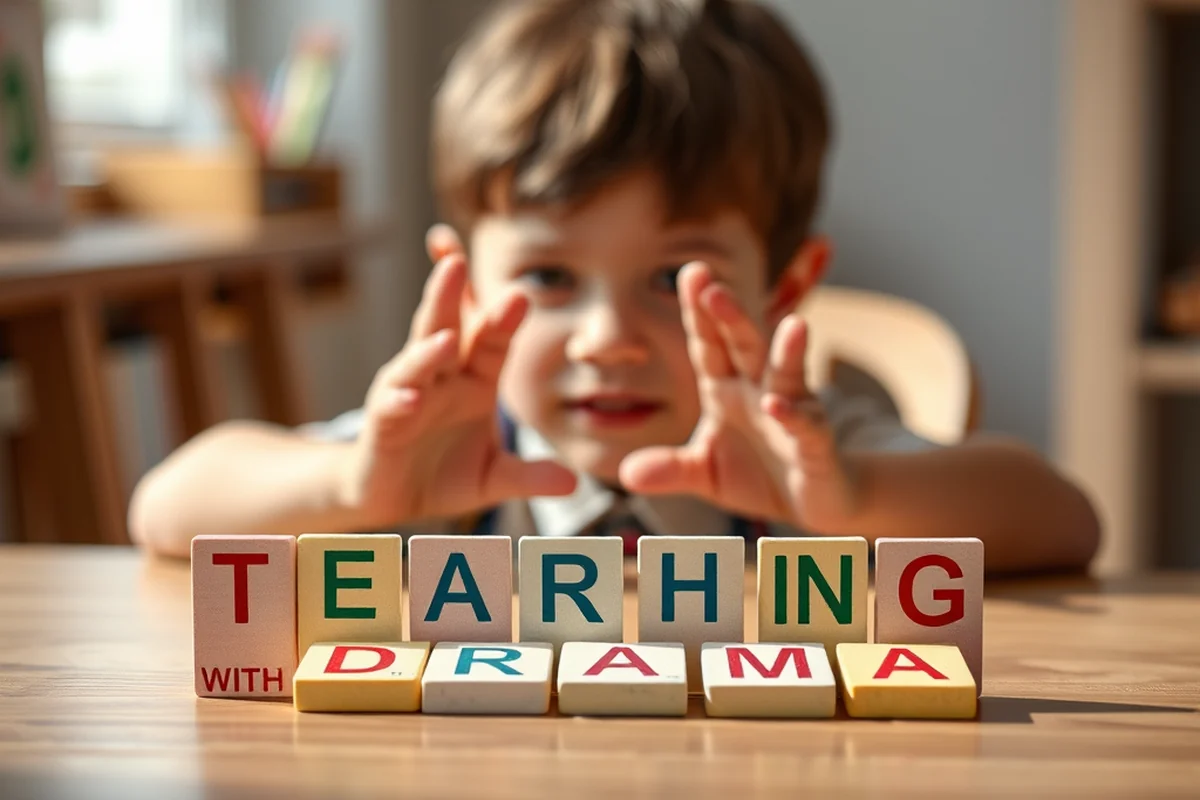
Drama works because it gives students a chance to experience what they're learning in a way that textbooks can't. When you ask a child to step into the role of a historical figure, they're not just reading about it — they're feeling it. This kind of immersive learning is far more effective than passive listening. I've seen students who were previously disengaged become fully invested in a lesson simply by stepping into a character's shoes.
One of the most powerful aspects of teaching with drama is the way it builds empathy. When students take on the perspectives of others, they begin to understand different viewpoints and emotions. In one of my classes, after performing a scene from *To Kill a Mockingbird*, students had a deep and meaningful discussion about prejudice and justice — something that would have been much harder to achieve through a traditional lesson.
Another benefit is that drama encourages collaboration and teamwork. When students work on a group performance, they learn how to listen, support each other, and contribute to a shared goal. It's a powerful way to build classroom culture and foster a sense of community.
Drama doesn't just teach — it transforms.
Related: Teaching english drama
Related: Teaching kids drama
Related: Teaching korean drama
Related: Teaching of drama
Related: Teaching drama in secondary school
How to Get Started With Teaching With Drama
Getting started with teaching with drama doesn't require a lot of resources — in fact, I've used drama effectively with just a few simple props and a classroom setting. The most important thing is to plan your lessons carefully. I often begin with a discussion or reading, then move into a role-play activity. The key is to make sure the students understand the context before they perform.
One of the best ways to begin is with a short role-play activity that's tied to the lesson. For example, if you're teaching about the water cycle, you can have students act out the different stages — evaporation, condensation, and precipitation. This not only makes the lesson more engaging, but it also helps students remember the information in a more lasting way.
I've found that allowing students to explore their own ideas within a structured framework is the most effective way to use drama. Rather than giving them all the lines, I let them create their own dialogue and actions, with some gentle guidance. This approach encourages creativity and ownership of the learning process.
Turn your classroom into a stage by using desks, chairs, and other objects as props. This makes the space more immersive and engaging for students.
“I remember the first time I used drama in my classroom — it wasn’t the sparkly costumes or the big stage that made it work…”— Teaching Drama to Kids editors
Making the Most of Drama in Your Classroom

To make the most of drama in your classroom, it's important to have clear objectives for each activity. I always start by asking myself: What do I want my students to learn or experience through this activity? Whether it's understanding a character's emotions, practicing public speaking, or exploring a historical event, having a clear goal helps the activity be more effective.
Active participation is also crucial. I've found that when students are fully engaged in a performance, they retain more information and are more invested in the learning process. This requires careful planning and a willingness to let students take risks and make mistakes — all part of the learning experience.
Finally, reflection is a key component of teaching with drama. After each activity, I take time to ask students questions like, 'What did you learn from this experience?' or 'How did you feel when you were in that role?' This helps them process their own learning and connect the experience to the lesson.
The Role of Teachers in Teaching With Drama
As a teacher, your role in teaching with drama is to guide, support, and facilitate the experience. This means creating a safe and encouraging environment where students feel comfortable taking risks and expressing themselves. I've learned that the more support I give my students, the more they're willing to engage in the activities.
One of the most important things I do is model the behavior I want to see. If I'm excited about a scene or activity, my students are more likely to be excited too. I also make sure to give positive feedback and encouragement throughout the process, which helps build confidence and motivation.
Another key role is to help students reflect on their experiences. After a performance or activity, I ask open-ended questions that encourage them to think about what they've learned and how they felt. This helps them make deeper connections between the activity and the lesson objectives.
The Impact of Teaching With Drama on Student Learning
I've seen firsthand how teaching with drama can transform student learning. When students are engaged in an activity, they're more likely to remember what they've learned. In my classroom, students who participate in drama activities consistently show higher levels of engagement and retention compared to those who don't.
One of the most impressive impacts I've seen is on student confidence. When students perform in front of their peers, they often come out of the experience with a newfound sense of self-assurance. This confidence translates into other areas of their learning and life, which is a powerful benefit.
Another measurable impact is on communication skills. I've noticed that students who regularly participate in drama activities are better at articulating their ideas, listening to others, and working collaboratively. These skills are essential for success in school and beyond.
Drama builds more than just skills — it builds confidence.
Making Drama Inclusive and Accessible
Making drama inclusive and accessible is an important part of teaching with drama. It means ensuring that all students, regardless of ability or background, can participate and feel valued. I've used a variety of adaptations to make my activities more inclusive, such as providing visual aids, allowing students to choose their roles, and incorporating movement-based activities.
One of the most effective ways to make drama inclusive is to give students choices. When I let them pick which characters they want to play, it increases their engagement and investment in the activity. I've also used sensory-friendly approaches, like allowing students to move around the classroom during performances, which helps those who struggle with sitting still.
Another way to make drama accessible is to use language and content that's familiar and relevant to all students. This helps them connect with the material and see themselves reflected in the stories and characters. When students feel seen and heard, they're more likely to participate and learn.
🎭 Younger Kids (Ages 3-6)
Use simple role-play and movement-based activities to engage young children and build foundational communication skills.
🎭 Older Kids (Grades 4-6)
Introduce more complex scenes and character exploration to develop critical thinking and performance skills.
🎭 No-Prep Version
Use the classroom environment as a stage and rely on student imagination for all scenes and props.
🎭 Group Version
Create collaborative performances that require teamwork, coordination, and shared leadership among students.
🎭 Extension Activity
Add writing or reflection components to build on drama activities and deepen understanding of the material.
| The mistake | Why it happens | The fix |
|---|---|---|
| Not providing enough structure or guidance | Students may become confused or disengaged if they don't know what's expected of them during a drama activity. | Plan your activities carefully and provide clear directions before beginning. Use examples and modeling to help students understand the task and how to approach it. |
| Focusing too much on performance rather than learning | If the goal is just to have students perform, they may miss the deeper learning that drama can provide. | Always frame drama as a learning tool. Use it to explore concepts, build empathy, and enhance understanding, not just for entertainment. |
| Not allowing enough time for reflection and discussion | Students may not fully understand the lessons or insights gained from a drama activity without time to reflect and discuss. | After each activity, take time to ask open-ended questions and encourage students to share what they learned and how they felt. |
| Ignoring the needs of all students | Students with different abilities, backgrounds, or learning styles may not feel included or supported during drama activities. | Make sure your activities are inclusive and accessible to all students. Provide choices, use adaptive strategies, and create a safe and welcoming environment for everyone. |
Teaching With Drama
Common Questions
How can I incorporate drama into my lesson plans without spending a lot of time or money?
What if some students are shy or reluctant to participate in drama activities?
Can drama be used for subjects other than literature or drama classes?
How can I measure the effectiveness of drama in the classroom?
References
- (PDF) Learning How to Use Drama in the Classroom: A Student Teacher's ... (academia.edu)
- Key Concepts in Theatre/Drama Education - Springer Nature (link.springer.com)
- Using Drama as an ESL Teaching Method - BridgeUniverse - TEFL Blog, News, Tips & Resources (bridge.edu)
- Using drama as an effective pedagogical tool to teach literature (commons.emich.edu)
Cite this guide
Teaching Drama to Kids (2026). Teaching With Drama. https://dramaplayarea.com/teaching-with-drama/
Feel free to cite or share this guide.